What a unit stills photographer actually does on set
There are two photographers' jobs on a film set and they are usually done by the same person on the same day. One of them ends up on the poster. The other ends up on the production's social feed, and years later it is the one the crew still has printed.
The two jobs in one day
Unit stills are the frames that represent the film to the outside world. They match the look of the film, they are shot from close to the camera's position, and they are what a distributor, a festival programme or a streaming platform reaches for. They need to work as a single image with no context around them.
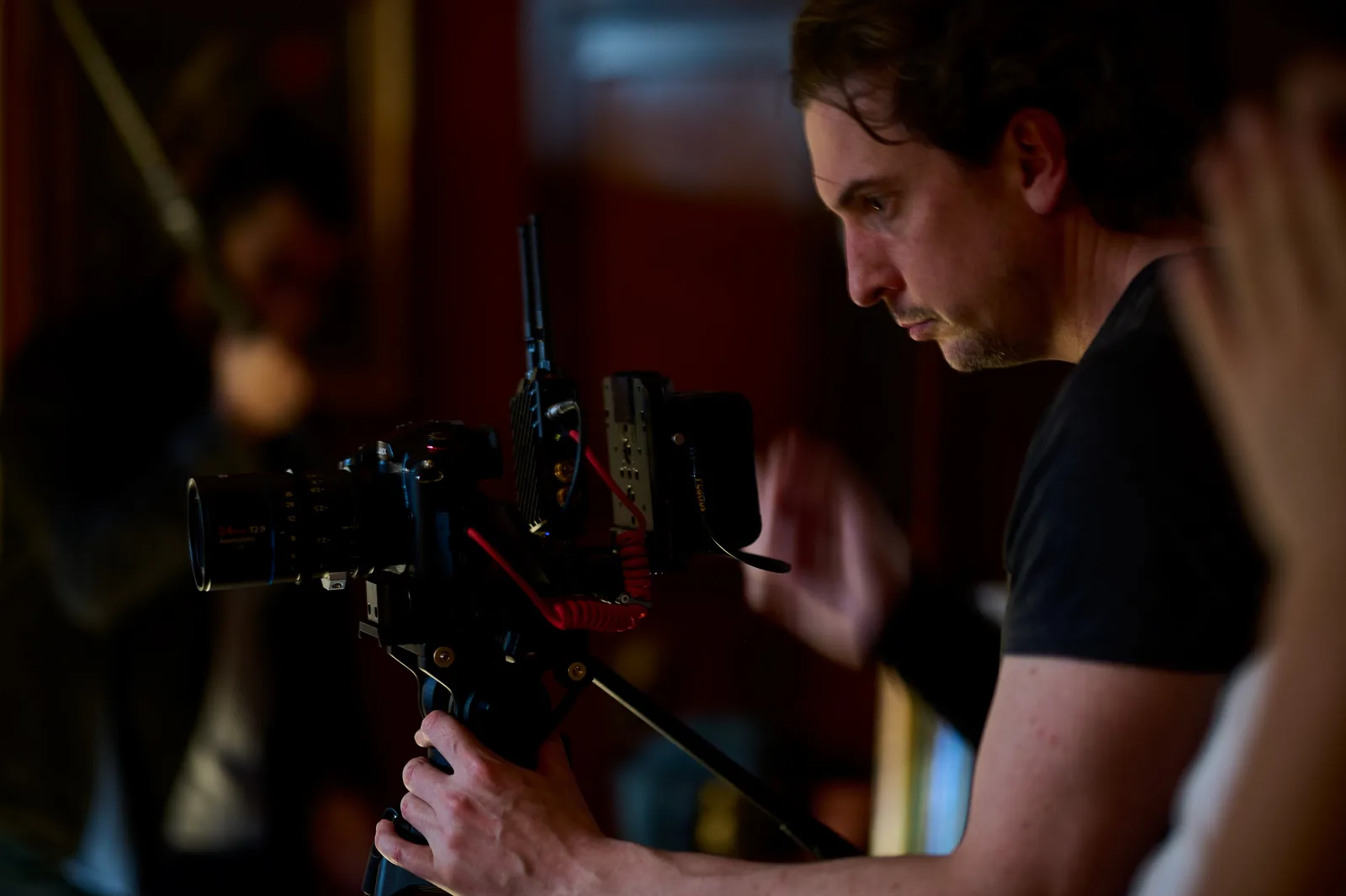
Behind the scenes photography is the other half: the crew at work, the rigging, the director in conversation with an actor, the moment before a take and the moment after it. It is the material that makes an audience feel let in, and it is the material a production posts while it waits for a release date.
Most productions want both, which is why I shoot both on the same day. The difference is where I stand and what I am waiting for.
Where I stand, and why it is usually behind the operator
For a unit still, the closer I am to the taking lens, the closer the frame is to what the film will look like. So I work just off the operator's shoulder, matching focal length where I can, and I take the frame on the same beat the scene turns. Step too far to either side and the geometry no longer matches the film, which is what makes a still look like a photograph of a set rather than an image from the story.
For behind the scenes I do the opposite. I go wide, take in the rig and the room, and wait for the thing that only happens between takes.
What the camera department needs from me
Silence, mostly. A modern mirrorless body is quiet, and where a set needs it quieter still there are blimps and sound-dampened housings. Beyond that it is spatial awareness: eyelines, the boom's path, the dolly track, the sparks' cable runs, and the piece of floor the focus puller needs to stand on. The first AD should never have to look for me.
I do not ask for a moment to be repeated, and I do not shoot over a take unless I know the sound department is happy. Everything else is negotiable. That is the whole etiquette, and it is the reason a production lets a photographer on set at all.
Rehearsal, first team, and the frames you only get once
The useful frames cluster in predictable places. Blocking rehearsal, when the director is on their feet with the actors. The first take of a new setup, when the room is alert. The turnaround, when the crew is moving and the light is changing. And the wrap of a difficult scene, when everyone in the room reacts at once.
Those last two cannot be recreated later, which is why I stay for the turnaround rather than taking it as a break.
What lands in your gallery at the end
A selection of the best frames, sorted, cropped and colour graded, in a private gallery you can share with your publicist. Usually 20 to 30 images for every hour of shooting. Not everything I take, because a production does not want to sift 900 frames, and a stills photographer who hands over everything is passing their job to you.
How to brief one
Send the script, or at least the scenes being shot. Send the call sheet. Say what the images are for, because a poster frame, a press kit and an Instagram grid want different things. Tell me about any closed set, NDA or cast approval before the day rather than on it. And tell me if there is a moment you already know you want, because most directors have one in mind and almost none of them mention it.
If you have a production coming up, tell me the dates and where you are shooting and I will come back with availability and a quote. You can see what a day covers, and what it costs, on the behind the scenes and unit stills page.